Stargazing forecast
Stargazing Forecast Tonight
When it is dark enough, when the Moon is out of the way, and which hours have the least forecast cloud — for the place you choose, in its local time.
Where will you look up tonight?
Search a town, park or dark-sky site to see darkness, moonlight and cloud hour by hour.
- Tonight and tomorrow night
- Moon and cloud shown separately
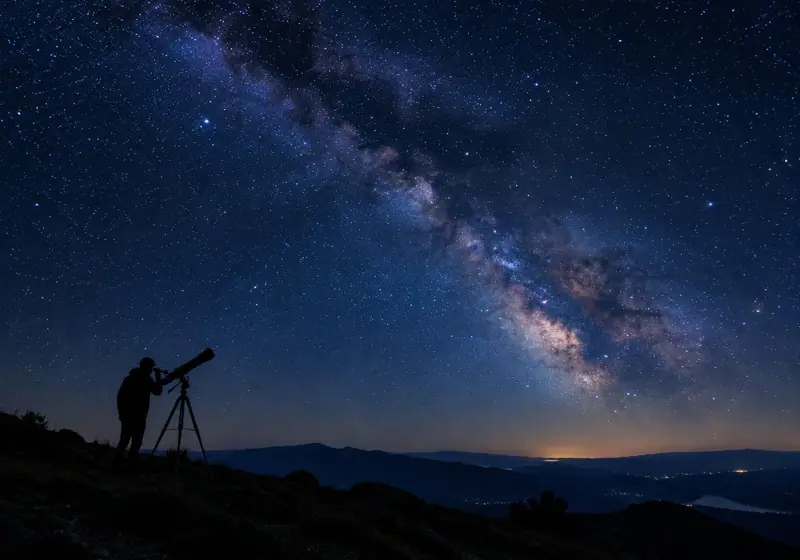
Choose a place in the tool above to see tonight's dark-sky hours.
Plan a stargazing night in four steps
- Step 1
Choose your site
Search the place you will actually observe from — a park, a beach or a viewpoint outside town.
- Step 2
Check the Moon
See when the Moon is up and how bright it is. The darkest hours are often before moonrise or after moonset.
- Step 3
Read the cloud hours
Each hour shows forecast cloud and rain. The longest unbroken run of good hours is highlighted.
- Step 4
Go out at the right time
Arrive before the recommended window starts so your eyes have time to adjust.
How this forecast works
Darkness
Calculated from the Sun's position. Astronomically dark means the Sun is more than 18° below the horizon; between 12° and 18° most stars show but the faintest do not.
Moonlight
Moonrise, moonset, altitude and the share of the disc that is lit. A Moon below the horizon adds no light, whatever its phase.
Cloud and rain
From the Open-Meteo hourly forecast: total cloud, low/mid/high layers where supplied, precipitation and its probability. Nothing is filled in.
Hours are rated Promising (astronomically dark, ≤20% cloud, dry, Moon down or slim), Limited or Poor, and the longest unbroken run of the best hours is recommended. There is no overall score. Near midsummer at high latitudes the Sun never sinks far enough, and the tool says so instead of inventing a dark window.
Tips for a better night under the stars
Let your eyes adapt
Your night vision improves over many minutes in the dark. Avoid bright screens while you wait.
Use red light
A red torch or a phone in night mode keeps your eyes adjusted far better than white light.
Get away from lights
Even a short drive away from street lights reveals more stars than a perfectly clear city sky.
Find an open horizon
Hills, trees and buildings block low parts of the sky. A high or open spot shows more.
Dress for the night
Clear nights cool quickly. Bring layers, something to sit on and a warm drink.
Start simple
Bright planets, the Moon and familiar constellations are easy targets before you look for faint objects.
What it cannot tell you
- Light pollution at your spot — a clear city sky still hides most stars. Check a light-pollution map.
- Your horizon: trees, buildings and mountains are not modelled.
- Transparency, seeing, smoke or haze — the forecast has no reliable measure of these.
- Whether the Milky Way, a meteor shower or aurora will actually be visible. This is a weather-and-light outlook, not a guarantee.
Frequently asked questions
What makes a good night for stargazing?
Three things that this tool checks: the Sun far enough below the horizon for a dark sky, little or no moonlight, and low forecast cloud with no rain. A dark site away from city lights matters just as much, but that is not something a weather forecast can measure.
Why does the tool say there is no dark window?
Near midsummer at high latitudes the Sun never gets 18° below the horizon, so true astronomical darkness does not happen. The tool shows twilight hours as limited instead of inventing a dark window.
Does a full Moon ruin stargazing?
A bright Moon above the horizon washes out faint stars and the Milky Way. When the same Moon is below the horizon it adds no light, so the hours before moonrise or after moonset can still be good.
How far ahead can I check?
Tonight and tomorrow night, using the hourly forecast for the place you choose. Hours outside the received forecast are not assessed.
Will I see the Milky Way or the northern lights?
The tool cannot promise that. It describes weather and light conditions, not light pollution, haze, aurora activity or your local horizon.